China is a major sourcing base for stainless steel kitchenware, but a polished catalog does not prove consistent production. Buyers comparing Stainless Steel Mixing Bowls should look beyond price and product photos. Check the stated steel grade, bowl thickness, rim finish, surface consistency, and whether the base sits steadily on a worktop. Small details matter. A rolled edge should feel smooth, and the interior should be easy to clean, without visible pits or sharp seams. Request current specifications and sample pieces before discussing a large order. That is practical, not distrustful.
This guide considers Chinese manufacturers through details buyers can verify: production focus, customization options, quality-control steps, export experience, communication, and material documentation. A supplier may have broad capacity yet still be a poor fit for a particular bowl size, finish, or delivery schedule. Ask about product tolerances, packaging, inspection records, and how defects are handled. When possible, assess samples through ordinary kitchen tasks, including stacking, washing, and handling with wet hands. No shortlist replaces due diligence. Supplier websites can be incomplete, and claims deserve checking. The goal is to help buyers ask better questions, not to suggest that one factory suits every need.
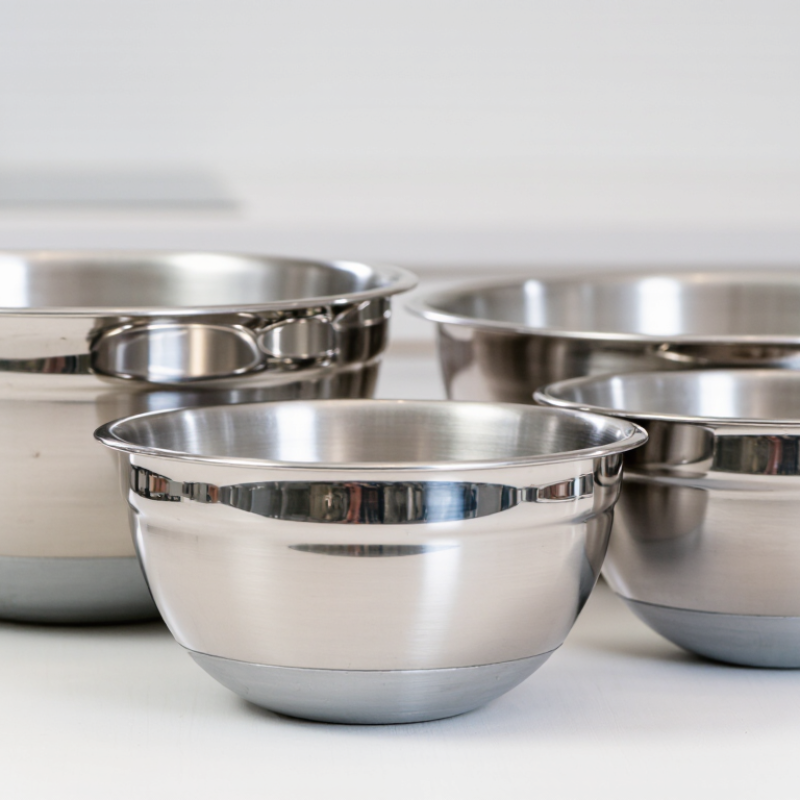
A stainless steel mixing bowl manufacturer is defined by more than access to sheet metal and forming equipment. Reliable producers understand how alloy choice, wall thickness, and bowl geometry affect daily use. They can explain whether a grade such as 304 suits the intended application and provide material records that support that claim. Details matter.
Manufacturing skill shows in the rim, base, and inner surface. A smooth rolled edge should feel comfortable in the hand, while a stable base helps prevent rocking during whisking. Consistent deep drawing reduces wrinkles and uneven walls. Welding, where used, should be cleanly finished, with no sharp edges or residue traps. Buyers can assess these points by reviewing samples and checking dimensions across several units, not just one polished sample.
A capable manufacturer also maintains repeatable quality checks, from incoming material inspection to final packing. Ask how staff verify bowl diameter, capacity, surface finish, and packaging protection. Clear answers and traceable records are more useful than broad promises. No production line is perfect; even a sound process can reveal defects in a new batch. A dependable supplier reports issues, investigates causes, and documents corrective steps. That practical transparency helps distinguish a true manufacturing partner from a simple trading intermediary.
Stainless steel mixing bowls begin with a practical design choice: capacity, wall thickness, rim shape, and base stability. Many are made from stainless sheet, pressed into shape by deep drawing, then trimmed and polished. The rim may be rolled to remove sharp edges and improve stiffness. A flat base helps the bowl stay steady while whisking, though very light bowls can still slide on a wet counter.
Material selection matters. Food-preparation bowls commonly use corrosion-resistant stainless grades, but the grade alone does not determine performance; forming quality, surface finish, and cleaning also matter. The World Stainless Association reported global stainless crude steel production of 58.4 million tonnes in 2023, up 4.6% from 2022. This indicates broad material availability, not a guarantee of bowl quality. Manufacturers should check dimensions, surface defects, rim smoothness, and batch consistency. Small dents can escape inspection. That deserves attention.
Tips: Look for a smooth interior, a securely finished rim, and a base that sits flat. If nesting bowls stick together, slightly varied diameters or curved sides can make storage easier. A mirror finish looks bright, but it may show scratches sooner; a brushed finish can hide them better.
Leading stainless steel mixing bowl manufacturers in China combine forming skills with dependable quality control. Their workshops may use deep drawing, trimming, polishing, and rim rolling to create bowls that stack neatly and resist everyday handling. On a good sample, the rim feels smooth, the base sits flat, and the interior has no obvious pits or sharp marks.
Small details matter. Buyers should ask about steel grade, sheet thickness, surface finish, and available sizes. A thin bowl can feel light but may flex during vigorous mixing. A heavier one may be sturdier, though less convenient to store. Ask for material records and inspection details, then compare them with a production sample. A polished sample is not the whole story.
Experienced manufacturers can often adjust capacity, shape, or packaging for different kitchen uses. Still, customization can add time and cost, and not every requested finish will look identical across batches. Check how the supplier handles dimensional checks, surface inspection, and sample approval before placing a large order. Clear communication helps, but it is not a substitute for checking the goods yourself. During evaluation, inspect the rolled edge and stacking fit in person, if possible. Those simple checks can reveal more than a catalog photo.
The chart compares specified chromium and nickel content by mass for stainless steel grades 304, 316, and 430. These material specifications can help when assessing mixing bowl product requirements; they do not rank manufacturers. Actual product materials should be confirmed with the supplier. Composition ranges are based on ASTM A240/A240M.
Choosing a stainless steel mixing bowl manufacturer in China takes more than comparing prices. Ask for the steel grade and mill test documents, then check that the records match the material used in production. Measure bowl thickness at several points, especially around the base and rim. Thin areas may flex under a heavy dough load. Inspect rolled edges, seams, and interior polish under direct light. Small dents matter. Rough spots can make cleaning harder and may indicate inconsistent finishing. Request samples from a routine production run, not just a hand-finished display piece.
Production capability is best assessed through evidence, not promises. Ask how forming, polishing, and inspection are organized, and whether workers record measurements by batch. Review the factory’s equipment and recent output records against your expected order volume and delivery schedule. A large monthly capacity figure means little if quality varies between shifts. Some checks take time. If an on-site visit is not practical, request a live video walkthrough and dated images of current production. A polished sample can still hide uneven batch control. Even a careful audit misses things; check the first shipment closely and record any differences in thickness, finish, or dimensions.
China Top Stainless Steel Mixing Bowl Manufacturers?
When sourcing mixing bowls from China, assess the factory’s process, not just its catalogue. The World Stainless Association’s Stainless Steel in Figures 2024 reports 58.4 million tonnes of global stainless steel production in 2023. That scale shows broad material availability, but it does not verify any supplier’s grade or workmanship. Ask for mill certificates and confirm that the specified steel matches your order. “18/8” is useful shorthand, not a substitute for documented composition.
Inspect samples for more than a mirror finish. Check rim smoothness, bowl-wall thickness, base stability, and whether nested bowls separate easily. Ask how the factory controls thickness across production runs and handles polishing marks or dents. A handheld XRF test can screen key alloy elements, but it does not reliably measure carbon; use suitable laboratory testing when grade verification matters. No checklist catches every defect.
Review food-contact documentation for your target market, along with inspection records, carton strength, lead times, and minimum order quantities. Request a pre-production sample, then compare it with a random unit from the finished batch. Confirm tolerances in writing, including capacity and diameter. A sample can look excellent while bulk consistency slips. That risk deserves attention. I would also clarify who pays for rework if inspection finds a mismatch.
| Sourcing Dimension | Common Options or Practical Benchmark | What to Confirm with the Supplier |
|---|---|---|
| Stainless steel grade | Food-preparation bowls are commonly offered in grades such as 304 and 201. Grade 304 is generally more corrosion-resistant; grade 201 is often selected for lower-cost products. | Specify the required grade in the purchase agreement. Request material documentation and, where appropriate, independent material verification; do not rely on appearance alone. |
| Material thickness | Lightweight bowls may use thinner sheet, while heavier-duty designs use thicker sheet. Actual thickness varies by size, forming method, and intended use. | Agree on a minimum thickness in millimetres, define the measurement location, and check samples for consistency, dents, sharp edges, and excessive flex. |
| Capacity and dimensions | Common household sets range from small prep bowls to large bowls of several litres. Capacity, rim diameter, height, and nesting clearance depend on the design. | Request a dimensioned drawing and usable-capacity definition. Confirm whether stated capacity is brim-full or practical working capacity. |
| Surface finish | Typical finishes include polished, brushed, and satin surfaces. The interior and exterior may have different finishes. | Approve a reference sample and specify acceptable scratches, polishing marks, surface uniformity, and cleaning requirements. |
| Rim and edge construction | Rims may be rolled, reinforced, or formed with a simple edge. Construction affects handling comfort and rigidity. | Check that edges are smooth and free from burrs. Assess rim strength and comfort by handling production-representative samples. |
| Base design and stability | Bowls may have a flat, rounded, or reinforced base. Some designs include a non-slip base or silicone components. | Confirm stability on a level work surface, base dimensions, component attachment, and whether any added materials are suitable for the intended use. |
| Set configuration | Sets can combine multiple bowl sizes and may include lids, measuring marks, or accessories. Each addition can affect packing and inspection requirements. | List every component, size, material, and finish in the specification. Confirm that lids fit securely and that accessories are included in the approved sample. |
| Food-contact compliance | Requirements depend on the destination market and the product’s materials and intended use. A supplier’s general compliance statement may not cover every component. | Identify the applicable destination-market requirements and request relevant, current test reports or declarations for the exact product and materials. |
| Packaging and shipping protection | Options include individual protective sleeves, dividers, retail boxes, and export cartons. Nested bowls need protection against rubbing and deformation. | Approve the packing configuration and carton specifications. Check sample-packed goods for movement, surface damage, and efficient container loading. |
| Production and quality control | Quality checks can cover incoming material, forming, polishing, dimensions, appearance, and final packing. | Agree on inspection criteria, sampling approach, defect classifications, and corrective-action procedures before mass production. |
| Minimum order and lead time | Minimum order quantities and production schedules vary with bowl design, tooling, finish, packaging, and factory workload. | Request written quotations for the required quantity and configuration. Confirm sample timing, production lead time, and how schedule changes are handled. |
| Supplier capability and verification | Suppliers may have different capabilities for forming, polishing, assembly, packaging, and export coordination. | Confirm which processes are performed in-house or subcontracted. Review relevant production evidence, sample consistency, and communication in writing. |
Benchmarks are indicative, not universal specifications. Final requirements should be documented in the product drawing, approved sample, and purchase agreement.