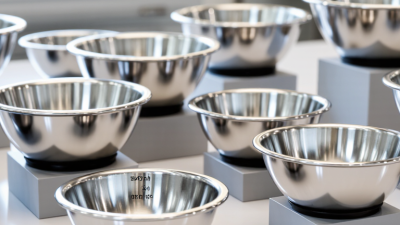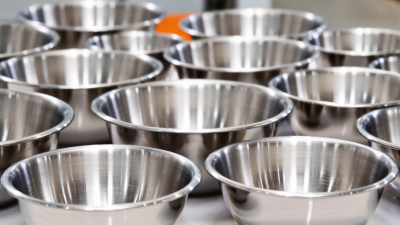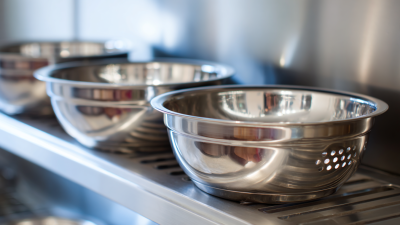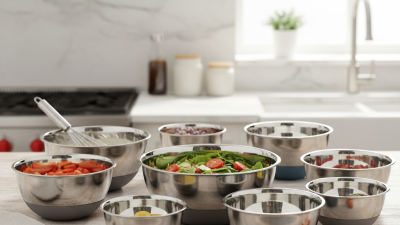
Finding the China best stainless steel cooking bowls manufacturer takes more than comparing prices or polished product photos. Buyers should look closely at material specifications, forming quality, surface finish, and the supplier’s ability to maintain consistent production. Stainless Steel Cooking Bowls may look simple, but small differences matter: a rolled rim should feel smooth, the base should sit evenly, and the interior should be easy to clean.
Ask manufacturers to clarify the stainless steel grade, bowl dimensions, thickness, and available finishes. Request product samples when possible, then inspect them under ordinary kitchen conditions. Check for sharp edges, uneven polishing, and lids or accessories that fit as promised. Small details matter. Production records, quality-control procedures, and relevant test documentation can help support supplier claims, though documents should be reviewed for scope and validity rather than accepted at face value.
For a custom order, discuss minimum quantities, packaging, logo options, lead times, and how defects are handled before confirming specifications. Clear communication is useful, but it is not proof of manufacturing capability. That takes checking. A factory visit or independent inspection may provide additional confidence when order size or risk justifies the cost. No single manufacturer is best for every buyer; the right choice depends on product requirements, budget, and expected service. Even a careful review has limits, so leave room for follow-up questions and sample testing before committing to a larger order.
For a cooking bowl, the steel grade matters more than a polished surface. ASTM A240/A240M, which covers stainless steel plate, sheet, and strip, specifies 18–20% chromium and 8–10.5% nickel for Type 304. Chromium helps form a passive surface layer that resists corrosion. That matters. But 304 is not stain-proof: salty food, moisture, and rough cleaning can leave marks, especially when residue sits in scratches or rolled edges.
The World Stainless Association’s Stainless Steel in Figures 2024 reports 58.4 million tonnes of global crude stainless steel production in 2023. That scale shows the material’s broad industrial use, not the quality of any particular bowl. Ask suppliers for material test documents that identify the grade and heat number, then check that the paperwork matches the batch. Portable X-ray fluorescence can help verify chromium and nickel, but it generally cannot measure carbon accurately. A neat mirror finish is useful to inspect, but it cannot confirm composition.
For stainless steel cooking bowls, Type 316 is worth considering when they may regularly contact salty foods, brines, or damp ingredients. Its usual 2–3% molybdenum improves resistance to pitting and crevice corrosion, especially in chloride-rich conditions. That can matter around rolled rims, seams, and spots where water lingers after washing. Type 304 often suits ordinary kitchen use, but 316 offers a useful margin in harsher settings. It is not magic.
A bowl’s performance still depends on its finish, construction, and care. Scratches, trapped food, harsh cleaners, or prolonged salt exposure can affect the surface over time. I would not treat the alloy grade alone as a guarantee. Ask the manufacturer to confirm the material specification, and check that the bowl has a smooth, well-finished interior with no rough seams. For a busy kitchen handling brined foods, the added corrosion resistance may justify choosing 316. For occasional dry mixing, it may be more than you need.
A stainless bowl’s performance starts with its wall thickness. Thin walls dent more easily and can feel unstable when whisking thick batter. Common U.S. sheet-metal gauge tables place 18-gauge stainless near 1.2 mm, but gauge conventions vary; specify millimeters and the applicable material standard. ASTM A240/A240M covers stainless steel plate, sheet, and strip, not a bowl’s complete performance. The World Stainless report Stainless Steel in Figures 2024 estimates 58.4 million tonnes of crude stainless steel production in 2023. That scale says little about an individual bowl’s quality. Check its actual thickness, finish, and construction.
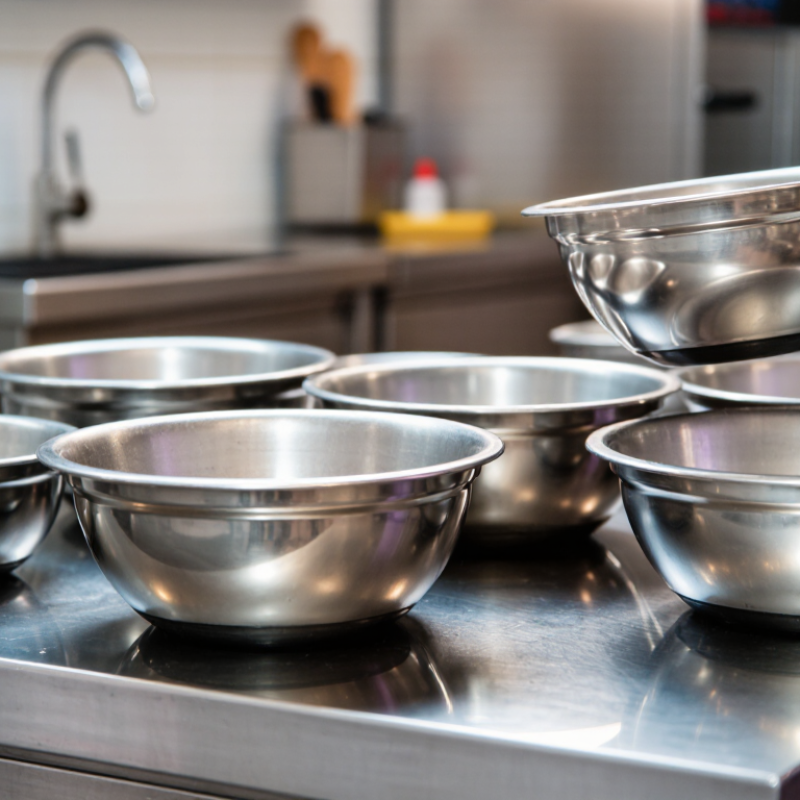
Capacity should match the task: a small bowl keeps one whisked egg manageable, while a larger bowl leaves room to toss salad without spilling. A rolled rim gives fingers a firmer grip and helps resist deformation, though a heavy rim can make pouring less neat. Nesting saves shelf space, but tightly stacked bowls may stick together or scratch. A slight size step and a smooth, consistent finish help them separate.
Tips: Test a nested set by lifting one bowl from the middle. For regular whisking, choose a stable base and a rim that feels comfortable when wet. There is no perfect bowl; a design that stores neatly may still pour awkwardly.
| Design Dimension | Typical Specification | Effect on Performance | Practical Selection Guidance |
|---|---|---|---|
| Steel Grade | Food-contact bowls are commonly made from 18/8 or 18/10 stainless steel, generally corresponding to Type 304 stainless steel. | Type 304 offers good corrosion resistance for ordinary kitchen use. Stainless steel is nonporous when intact and does not readily retain food odors. | For routine mixing and food preparation, check that the material grade is clearly specified. Avoid assuming that a polished finish alone indicates a particular steel grade. |
| Material Gauge | Common bowl walls are approximately 0.5–1.0 mm thick. For reference, 18-gauge stainless steel is about 1.2 mm and 22-gauge is about 0.8 mm; exact gauge conversions can vary by standard. | Thicker walls generally feel more rigid and are less prone to denting or flexing. Thinner walls reduce weight and cost but may deform more easily under impact. | Choose a heavier wall for frequent commercial handling or large bowls. For occasional household mixing, a lighter bowl may be easier to lift and store. |
| Capacity | Common sizes range from about 0.5 L for small prep bowls to 5 L or more for large mixing bowls. | Capacity determines batch size and available headroom. A bowl filled close to its rim can be difficult to whisk or toss without spills. | For mixing, select a bowl with enough room for ingredients to move freely. A set of several capacities is useful for separating ingredients and preparing different batch sizes. |
| Bowl Diameter and Depth | Shallow, wide bowls provide a larger working surface; deeper bowls contain ingredients more effectively during vigorous mixing. | A wider opening makes adding ingredients and using a whisk easier. Greater depth helps limit splashing, while a narrow opening can restrict utensil movement. | Match the shape to the task: wider bowls for whisking and tossing, and deeper bowls for batters or mixing ingredients that may splash. |
| Rim Construction | Typical designs include a rolled edge, a reinforced rim, or a simple formed edge. | A rolled or reinforced rim can improve stiffness and provide a smoother edge to hold. Rim shape also affects pouring control and how securely bowls stack. | Check that the edge is smooth and free of burrs. If frequent pouring is expected, compare the rim profile and bowl shape using the intended contents. |
| Base Stability | Most mixing bowls have a rounded or gently curved base; some designs use a flatter contact area. | A flatter base can sit more steadily on a countertop. A rounded base allows ingredients to move around the bowl more readily but may rock during vigorous mixing. | For hand whisking, look for a stable contact area or use a damp towel beneath a rounded bowl. Confirm stability on the surfaces where the bowl will be used. |
| Nesting and Stackability | Nesting bowls are shaped to fit inside one another, usually with a small gap between adjacent bowls. | Consistent taper and rim dimensions help bowls stack compactly. Tight-fitting bowls may be difficult to separate, while excessive clearance uses more storage space. | When buying a set, check the stacked height and whether each bowl can be removed without forcing or scraping. Compare nesting with lids, if lids are included. |
| Surface Finish | Common finishes include polished, brushed, and satin finishes. | Finish mainly affects appearance and visible marks; it does not by itself establish the steel grade or wall thickness. Scratches can occur with normal use. | Choose a finish based on appearance and cleaning preference. Follow care instructions and avoid abrasive cleaners if maintaining a polished surface matters. |
| Measurement and Quality Checks | Useful checks include wall thickness, capacity, diameter, height, rim smoothness, and fit when nested. | Clear specifications make bowls easier to compare and help reduce variation across a set. Actual capacity can differ depending on whether it is measured to the brim or to a usable fill level. | Ask for dimensions and capacity measurement methods, and inspect samples for consistent shape, smooth edges, stable bases, and easy separation when nested. |
Note: Specifications shown are general selection references, not universal manufacturing standards. Gauge-to-thickness conversions, usable capacity, and product dimensions may vary by measurement system and design.
A dependable stainless steel cooking bowl manufacturer should show how quality is controlled, not just describe it. ISO 9001:2015 provides a framework for managing documented processes, corrective actions, and continual improvement. It does not guarantee that every bowl is flawless. Ask how inspections are carried out on the production floor. For example, workers may check rim smoothness, bowl dimensions, surface finish, and welds under consistent lighting. Clear acceptance criteria matter.
Traceability links a finished bowl to its production history. Records may identify the steel grade, supplier lot, production date, inspection results, and packaging batch. If a surface defect appears, these details help the factory investigate the affected lot instead of guessing. Good systems make records easy to retrieve and connect them to real products. Paperwork alone is not enough; occasional gaps can happen, so review how issues are corrected and whether follow-up checks confirm the fix.
Tips: Request a sample inspection record and ask how a batch is traced backward to its steel source. Check that the sample matches the stated finish and dimensions. A certificate is useful, but direct evidence is better. Notice how clearly the manufacturer answers specific questions.
China Best Stainless Steel Cooking Bowls Manufacturer?
How to Compare Suppliers: Match Steel Grade, Testing, Certifications, and Order Needs
A bowl’s shine does not prove its steel grade. Ask suppliers to specify the alloy, such as 304 or 201, on the quotation and product documents. Grade matters: 304 typically offers better corrosion resistance than 201, while 316 contains molybdenum for added resistance in demanding environments. The World Stainless Association’s Stainless Steel in Figures 2024 reports 58.4 million tonnes of stainless steel produced in 2023. Scale is large; supplier quality still varies.
Request a material test certificate and check that its heat or batch number matches your order. Independent X-ray fluorescence testing can help verify chromium and nickel, but it does not reliably measure carbon. Inspect bowl samples for rolled rims, smooth welds, and consistent thickness. Ask which food-contact documents apply to your destination market; a certificate alone does not prove every bowl meets every requirement. A glossy sample can still conceal uneven production. I would verify one more batch.
Tips: Confirm grade, test method, certificate scope, minimum order quantity, lead time, and packaging before paying a deposit. Ask for a sample from the actual production process, not only a showroom piece. Small details matter.