10 Tips for Buying a Large Stainless Steel Bowl
A Large Stainless Steel Bowl can look simple, but its performance depends on details users often overlook. Capacity, steel grade, rim design, stability, and cleaning access all affect daily work. A bowl that feels solid on a showroom shelf may slide during vigorous whisking. That small failure becomes frustrating in a busy kitchen.
World Stainless reported approximately 58.4 million tonnes of stainless steel production in 2023. This scale reflects the material’s importance across foodservice, manufacturing, and household applications. However, production volume does not guarantee product quality. Buyers still need to examine alloy information, weld finishing, thickness, and supplier documentation. The FDA Food Code 2022 emphasizes food-contact surfaces that are smooth, corrosion-resistant, nonabsorbent, and easily cleanable. NSF/ANSI 2 also provides recognized requirements for commercial food equipment. These references offer a stronger basis than appearance alone.
Small details matter.
This guide presents ten practical tips for choosing the right bowl. It considers mixing dough, washing vegetables, preparing sauces, and storing ingredients. It also explains why 304 stainless steel is commonly preferred for demanding food environments. Still, 304 is not automatically perfect for every application, especially where salt, acids, or harsh cleaners are involved. I have learned that advertised capacity can feel misleading when measured to the rim. Usable capacity matters more, particularly when ingredients need room to move. Weight, nesting space, handles, and noise should also influence the decision. Some recommendations may seem obvious, but busy kitchens often expose the details buyers missed.
Define Your Cooking Needs and Ideal Bowl Capacity
Define Your Cooking Needs and Ideal Bowl Capacity
A large stainless steel bowl should match your actual cooking habits, not an imagined professional kitchen. For salad preparation, pancake batter, or tossing vegetables,
a 5- to 7-quart bowl usually provides useful working space.
A 10- to 12-quart bowl suits bread dough, party-size salads, or several kilograms of marinated food. Measure your largest recipe before shopping. That small step prevents an expensive mismatch.
The U.S. Department of Agriculture reports that roughly 30% of the food supply is lost or wasted. Oversized bowls can encourage unnecessary batch cooking and larger leftovers. I once chose a deep bowl for convenience, but it occupied half a cabinet and rarely felt practical. My estimate was wrong. Think about serving numbers, storage space, and whether you use a hand mixer. A bowl that is too shallow can spray batter across the counter.
Material quality still matters. The FDA Food Code 2022 identifies food-contact surfaces as needing to be smooth, corrosion-resistant, and easily cleanable. Look for a stable base, rolled edges, and a depth that keeps ingredients contained. A 6-quart bowl may be ideal for weekly family meals, while a 12-quart model may suit occasional entertaining. Do not buy capacity you cannot lift comfortably. Wet dough becomes surprisingly heavy. Check the interior markings, too, although printed measurements can fade or prove imperfect over time.
Evaluate Bowl Shape, Stability, Handles, and Useful Features
10 Tips for Buying a Large Stainless Steel Bowl
A large bowl should match how you actually cook, not just look impressive. A wide, gently sloped shape gives a whisk room to move and makes folding batter easier. Tall, narrow sides hold flour better, but they can make scraping difficult. I once chose depth over width and regretted it during bread mixing.
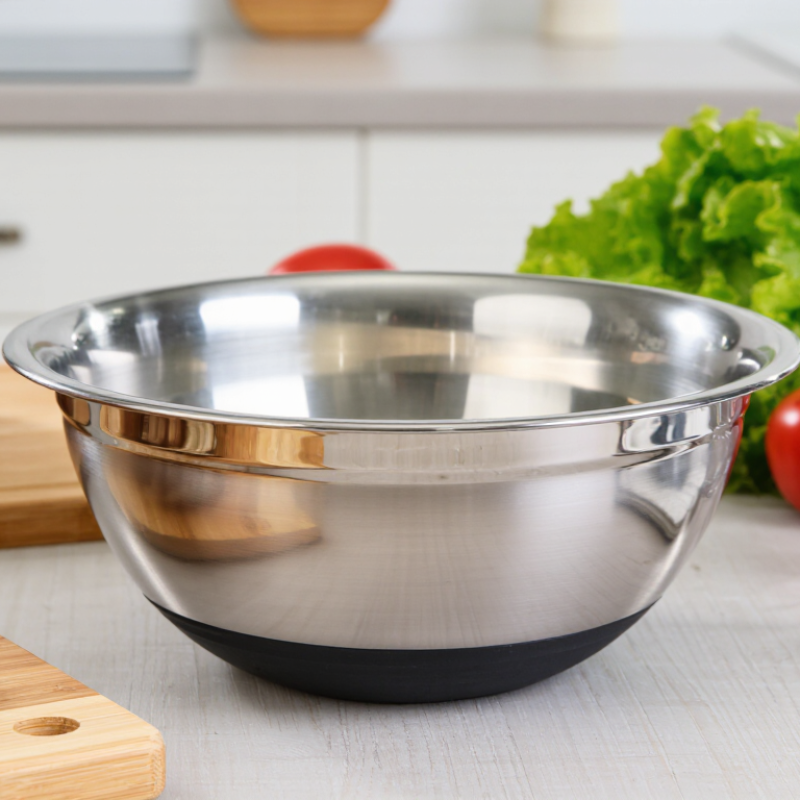
Check the base carefully. A broad, flat bottom resists tipping when you knead dough or toss a heavy salad. A silicone ring can improve grip on a wet counter, although it may trap water after washing. Small detail, big difference. Tap the rim and inspect the seams. Smooth, fully finished edges feel safer and usually show better manufacturing control.
Handles are useful when the bowl is filled with potatoes, fruit, or thick batter. They should provide enough finger clearance without making the bowl awkward to store. Welded handles often feel secure, but poorly finished joints can collect residue. Useful extras include interior measurements, a pouring lip, nesting compatibility, and a lid that fits firmly. Measurement marks may fade over time, so treat them as helpful guides rather than laboratory equipment. A stainless steel bowl with a stable base and practical handles is easier to trust, but oversized models can become heavy faster than expected. Check the empty weight before buying.
Compare Cleaning Ease, Storage Options, and Long-Term Durability
10 Tips for Buying a Large Stainless Steel Bowl
A large bowl should be easy to clean after mixing dough, washing vegetables, or preparing salad. Check the interior for smooth welds, rounded corners, and a polished surface without deep scratches. These details reduce places where food residue can hide. Confirm that the bowl is dishwasher-safe, but remember that oversized bowls may block the spray arms. I learned that the hard way.
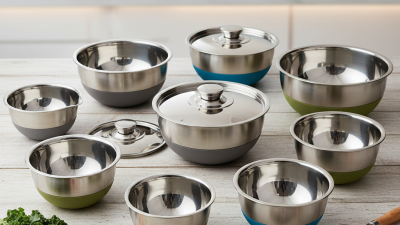
Look for a wide rim that gives your fingers a secure grip during washing. A stable base matters too, especially when whisking thick batter. Test whether the bowl nests neatly with your existing cookware before buying it. Measure both cabinet height and shelf depth. Some large bowls fit inside one another, while others waste valuable space because of broad rims or fixed handles. A hanging hole can help, but only if your storage area supports it. Otherwise, it becomes another dusty surface.
Long-term durability depends on steel quality, wall thickness, and construction. Food-grade stainless steel with strong, even walls usually resists rust and everyday staining. Still, “rust-resistant” does not mean indestructible. Avoid abrasive pads and chlorine-based cleaners, which can damage the surface over time. Inspect the underside for a flat, firmly attached base. I once ignored this detail, and the bowl rocked during mixing. Check the stated capacity carefully, since a bowl measured to its brim may hold less safely in real use. Look for clear care instructions and a practical replacement policy.
10 Tips for Buying a Large Stainless Steel Bowl: Cleaning, Storage, and Durability
Scores use a 1–10 practical benchmark for unbranded household bowls. Smooth, seamless interiors generally clean more easily; nesting designs save the most storage space; and thicker stainless steel usually provides better long-term durability.