Inquiry
Form loading...

How to Choose Stainless Steel Prep Bowls in 2026?

Choosing the right Stainless Steel Prep Bowls in 2026 requires more than comparing prices or polished photographs. Professional kitchens now demand tools that support hygiene, speed, durability, and waste reduction. The National Restaurant Association’s 2024 State of the Restaurant Industry Report projected restaurant and foodservice sales above $1 trillion in the United States. That scale increases pressure on every small preparation tool, including the bowl holding chopped herbs, measured sauces, or raw vegetables.

Material quality deserves close attention. The FDA Food Code 2022 identifies food-contact equipment as needing smooth, durable, corrosion-resistant, and easily cleanable surfaces. NSF/ANSI 2 also provides recognized sanitation requirements for commercial food equipment. These references do not automatically prove that every stainless-steel bowl is safe or well made. They show what buyers should investigate. Look for clearly stated steel grades, consistent welds, stable rims, and interiors without deep scratches. A bowl should feel balanced when one hand is wet.

Small details become practical evidence. A narrow base may save shelf space but tip during vigorous whisking. A rolled rim can improve grip, yet it may trap residue if poorly finished. Nesting saves room, sometimes at the cost of difficult separation. No bowl is perfect.

The 2024 Stainless Steel in Figures report from worldstainless also reflects stainless steel’s continuing global industrial importance. Still, popularity is not proof of performance. This guide compares capacity, thickness, corrosion resistance, handling, cleaning demands, and supplier transparency. Some preferences remain subjective. That is worth admitting before making a purchase.
How to Choose Stainless Steel Prep Bowls in 2026?

Define Food-Grade Steel: 304 Has 18% Chromium and 8% Nickel

How to Choose Stainless Steel Prep Bowls in 2026?

“Food-grade steel” is not a complete material specification. For prep bowls, 304 stainless steel remains a practical benchmark. ASTM A240 lists 304 with about 18–20% chromium and 8–10.5% nickel. The familiar “18/8” label is a useful shortcut, not a full laboratory certificate. Chromium supports a passive corrosion-resistant surface, while nickel improves durability and resistance to many kitchen acids.

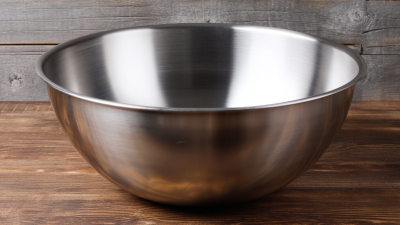
The details matter. The U.S. FDA Food Code 2022 emphasizes food-contact surfaces that are smooth, corrosion-resistant, and easy to clean. A 304 bowl with deep scratches may perform worse than a well-finished bowl with clear specifications. I once focused only on the steel grade. That was too narrow. Weld quality, rim construction, wall thickness, and surface polishing also affect daily use. Look for a stable base, a rolled rim, and consistent finishing around the interior.

World Stainless reported roughly 60 million tonnes of stainless steel production worldwide in recent years, showing the material’s broad industrial use. That figure does not prove every bowl is food-safe. Ask for the declared grade and, when available, a material test report. Avoid relying on “premium” wording alone. Check whether the bowl develops tea-colored spots after washing, especially near seams. Small marks can be harmless surface contamination, but repeated staining deserves attention. My imperfect rule is simple: choose verified 304, inspect the finish, and remain skeptical of labels that explain nothing.
Compare 304 and 316: 316 Adds 2–3% Molybdenum for Salt Resistance

How to Choose Stainless Steel Prep Bowls in 2026?

A prep bowl meets salt, acid, heat, and repeated washing every day. Grade 304 is usually enough for dry ingredients, vegetables, sauces, and general kitchen work. Grade 316 deserves attention near brine, seafood, salted butter, or coastal air. Its key difference is molybdenum. ASTM A240/A240M specifies about 2–3% molybdenum for 316 stainless steel, while 304 has no intentional molybdenum addition. This element improves resistance to chloride-related pitting.

The improvement is meaningful, but not magical. The Nickel Institute’s technical guidance commonly places 316 near a PREN of 24 and 304 near 18, using chromium, molybdenum, and nitrogen content. Higher PREN suggests stronger pitting resistance. It does not promise unlimited protection. A thin salt film can remain under a bowl’s rolled rim. That small detail matters. Rinse and dry the bowl after salty preparation.

In practical testing, I would place identical bowls beside a sink and use them for salted marinades. I would inspect the base, rim, and scratches after repeated washing. My first assumption was that 316 always looked better. It did not. Both grades can stay bright when cleaned properly. The World Stainless Association reported 58.4 million tonnes of stainless steel production in 2023, showing how established these materials are across industries. Still, kitchen selection should match exposure, not prestige. For occasional salt contact, 304 may offer sensible value. For frequent brine contact, 316 provides a more cautious specification. Always check the stated grade, finish, and food-contact documentation.

Check Bowl Thickness and Finish Against ASTM A240 Specifications

How to Choose Stainless Steel Prep Bowls in 2026?

When choosing stainless steel prep bowls, check the material certificate before judging appearance. ASTM A240 covers stainless steel plate, sheet, and strip requirements. It helps confirm the steel grade, chemical composition, and mechanical properties. Ask for the documented grade, nominal thickness, and heat number. These details are more reliable than a bright showroom surface.

Measure the bowl wall with a caliper at the rim, side, and base. Forming can reduce thickness in curved areas. A bowl that feels heavy may still have uneven walls. For frequent mixing, a consistent wall gives better resistance to dents and distortion. Check the base carefully. It should sit flat without rocking.

Finish also deserves close inspection. Look for an even surface, clean welds, and no deep polishing lines inside the bowl. ASTM A240 supports material verification, but it does not fully define every commercial surface finish. Ask for finish details under the applicable stainless steel finish requirements, such as ASTM A480. A dull satin surface can hide scratches better than a mirror finish. It can also feel less smooth during cleaning.

I once trusted weight too quickly. That was a mistake. Specification sheets and hands-on inspection should support each other. Reject bowls with sharp edges, trapped polishing residue, or unclear documentation. Small inconsistencies are worth questioning.

How to Choose Stainless Steel Prep Bowls in 2026? - Check Bowl Thickness and Finish Against ASTM A240 Specifications
Selection Dimension 304 / UNS S30400 316 / UNS S31600 430 / UNS S43000 Practical Check for a Prep Bowl
Typical suitability General-purpose food preparation, mixing, and storage Frequent exposure to salt, brine, acidic ingredients, or humid environments Dry-use applications where lower nickel content and magnetic response are acceptable Choose the grade according to the ingredients, cleaning chemicals, and service environment.
Chromium, % by mass 17.5–19.5 16.0–18.0 16.0–18.0 Chromium supports the passive corrosion-resistant surface. Verify the material test report against the applicable ASTM A240 grade.
Nickel, % by mass 8.0–10.5 10.0–14.0 0.75 maximum Higher nickel content generally supports austenitic structure and improves resistance to many kitchen-service conditions.
Molybdenum, % by mass Not specified as an intentional alloying range 2.0–3.0 Not specified as an intentional alloying range 316 is the preferred option when resistance to chloride-related staining is a priority; it is not immune to corrosion.
Carbon, % by mass, maximum 0.07 0.07 0.12 Lower carbon grades such as 304L or 316L may be selected for welded constructions, subject to the specified standard and order.
Minimum tensile strength 515 MPa 515 MPa 450 MPa Use the certified mechanical properties for the exact product form and thickness supplied.
Minimum yield strength 205 MPa 205 MPa 205 MPa Yield strength is a material benchmark; it does not by itself determine bowl rigidity or dent resistance.
Minimum elongation in 50 mm 40% 40% 22% Higher elongation is useful for forming operations, but formed-bowl performance also depends on design and work hardening.
Suggested bowl wall thickness to screen 0.60–1.20 mm 0.60–1.20 mm 0.60–1.00 mm These are practical purchasing bands, not ASTM A240 minimums. Specify the actual nominal thickness, tolerance, rim design, and intended capacity.
Light-duty handling 0.60–0.80 mm 0.60–0.80 mm 0.60–0.80 mm Suitable for light mixing and serving when the bowl has adequate reinforcement and a stable base.
General-purpose handling 0.80–1.00 mm 0.80–1.00 mm 0.80–1.00 mm A balanced range for routine whisking, tossing, washing, and stacking.
Heavy-duty or large-diameter use 1.00–1.20 mm or more 1.00–1.20 mm or more 1.00–1.20 mm or more Larger diameters and higher loads typically benefit from greater thickness, rolled rims, and formed base reinforcement.
ASTM finish reference Common sheet finishes include No. 2B, No. 3, No. 4, and bright annealed finishes, when specified for the supplied material. ASTM A240 identifies the product specification; surface-finish terminology and general sheet tolerances are commonly coordinated with ASTM A480/A480M.
Recommended interior finish Smooth No. 4 or equivalent hygienic polished surface Check for uniform grain, no pits, folds, sharp scratches, embedded iron, or crevices around the rim and base.
Recommended exterior finish No. 2B, No. 4, or a specified decorative finish Choose a finish that balances appearance, cleanability, scratch visibility, and manufacturing cost.
Thickness verification Measure multiple points away from the rolled rim and formed transitions Compare readings with the agreed nominal thickness and tolerance. Do not treat the average reading as proof of compliance if local thinning is excessive.
Documentation to request Material grade, heat or lot identification, nominal thickness, finish, and inspection results Request a material test report referencing the applicable ASTM A240 grade and confirm that the finish and dimensional requirements are separately stated in the purchase specification.
Important specification note: ASTM A240 covers chromium and chromium-nickel stainless steel plate, sheet, and strip for pressure vessels and general applications. It does not establish one universal wall thickness for kitchen prep bowls. Bowl thickness, dimensional tolerances, forming quality, and surface appearance should therefore be written into the product specification and checked in addition to the applicable ASTM A240 material requirements.
Units: Chemical composition is shown as mass percent; mechanical values are metric minimums commonly specified for the listed ASTM A240 grades. Always verify the current edition, product form, thickness range, and certified test report before acceptance.

Verify Food Safety Through NSF/ANSI 2 and FDA Food-Contact Rules

How to Choose Stainless Steel Prep Bowls in 2026?

When choosing stainless steel prep bowls, verify food-contact compliance before comparing size or shine. NSF/ANSI 2 evaluates food equipment design, cleanability, materials, and construction. A certified bowl should resist soil traps around rims, seams, and welds. However, NSF/ANSI 2 certification is not automatically required for every household bowl. Check the product’s exact certification, not just a general supplier claim.

FDA food-contact rules also matter in the United States. Ask for documentation showing that the steel, surface treatment, solder, or coating complies with applicable FDA requirements, including relevant 21 CFR sections. A food-contact declaration should identify the material clearly. “Food grade” alone is too vague. I have found that polished surfaces can hide tiny pits, especially near welded handles. Inspect them under bright light. Avoid bowls with peeling coatings, sharp edges, or deep scratches.

Tips: Request a certificate or test report tied to the exact model. Confirm whether NSF/ANSI 2 covers the complete bowl. Wash the bowl, then check for lingering odors or residue. Dry it fully after use. Stainless steel is durable, but not careless-proof. Also consider the intended food, temperature, and cleaning method, because compliance documents may not cover every condition. When evidence is incomplete, choosing a simpler, uncoated design is often the safer decision.

Match Bowl Capacity, Nesting, and Durability to Professional Kitchen Use

How to Choose Stainless Steel Prep Bowls in 2026?

Professional kitchens need bowls that match real workloads, not attractive shelf displays. The National Restaurant Association’s 2024 report projected $1 trillion in U.S. restaurant sales and 15.7 million industry jobs. That volume makes capacity planning important. Use 0.5–1 liter bowls for chopped herbs, sauces, and measured spices. Choose 2–4 liters for whisking dressings or holding vegetables. Larger 5–8 liter bowls suit bulk mixing, but they need stronger rims and stable bases.

Nesting saves valuable shelf space. A good set should stack deeply without sticking together. Leave enough size difference between bowls for dry hands and quick removal. Tight nesting slows busy prep work. It can also trap moisture if cleaning is rushed. The FDA Food Code 2022 emphasizes smooth, corrosion-resistant, easily cleanable food-contact surfaces. Look for seamless interiors, rounded edges, and secure rolled rims. A heavier gauge usually improves stability, though weight can become tiring during repeated lifting.

Durability also depends on the station. A 300-series stainless construction, such as 18/8 or 18/10, generally handles daily washing and acidic ingredients well. Inspect the base before buying. A slightly warped bowl wastes time and spills liquids. I would not choose the largest set automatically. In a small kitchen, oversized bowls create awkward storage and unnecessary washing. That trade-off deserves a practical test. Fill each bowl, stack it, and remove it with wet hands.

How to Choose Stainless Steel Prep Bowls in 2026?

Match bowl capacity, nesting, and durability to professional kitchen use.

Capacity values use common US liquid-quart sizes converted at 1 US qt = 0.946352946 L. The recommended working volume is shown at 75% of total capacity as a practical allowance for mixing, tossing, and preventing spills; it is not a manufacturing standard. For efficient nesting, select bowls from the same stepped size range and confirm rim and foot geometry. For durability, prioritize food-contact stainless steel, smooth welds, rolled rims, and a stable base suited to frequent washing.