Choosing the China Best Stainless Steel Basin Bowl Manufacturer requires more than comparing prices and polished product photos. The right supplier should demonstrate material knowledge, stable production, and dependable quality control. A professional manufacturer can explain stainless steel grades, wall thickness, forming methods, surface treatments, and drainage compatibility. These details affect durability, hygiene, appearance, and installation.
Details matter. During factory evaluation, buyers should inspect stamping equipment, welding points, polishing lines, and finished-bowl packaging. A reliable supplier should provide material certificates, sample approval records, inspection procedures, and clear production schedules. Experience with export packaging also matters, especially when bowls face vibration, moisture, and repeated handling during transportation. Customer references can reveal how the manufacturer handles revisions, defects, and after-sales communication.
The best Stainless Steel Basin Bowl supplier is not always the largest factory. That sounds simple. Not always. Some smaller manufacturers may offer closer communication and flexible customization, while larger facilities may provide stronger capacity and testing systems. Buyers should compare evidence rather than promises. Ask about tolerances, quality sampling, tooling ownership, replacement policies, and production traceability. Factory audits or independent inspections can reduce uncertainty before a large order begins.
This guide examines the practical standards behind a trustworthy Chinese manufacturer. It considers product performance, manufacturing experience, technical support, customization ability, and commercial reliability. No supplier is perfect, and even a strong factory may have limitations. Recognizing those limitations creates a more realistic purchasing decision. The goal is not merely to find a low quotation, but to identify a partner capable of delivering consistent basin bowls for the intended market.
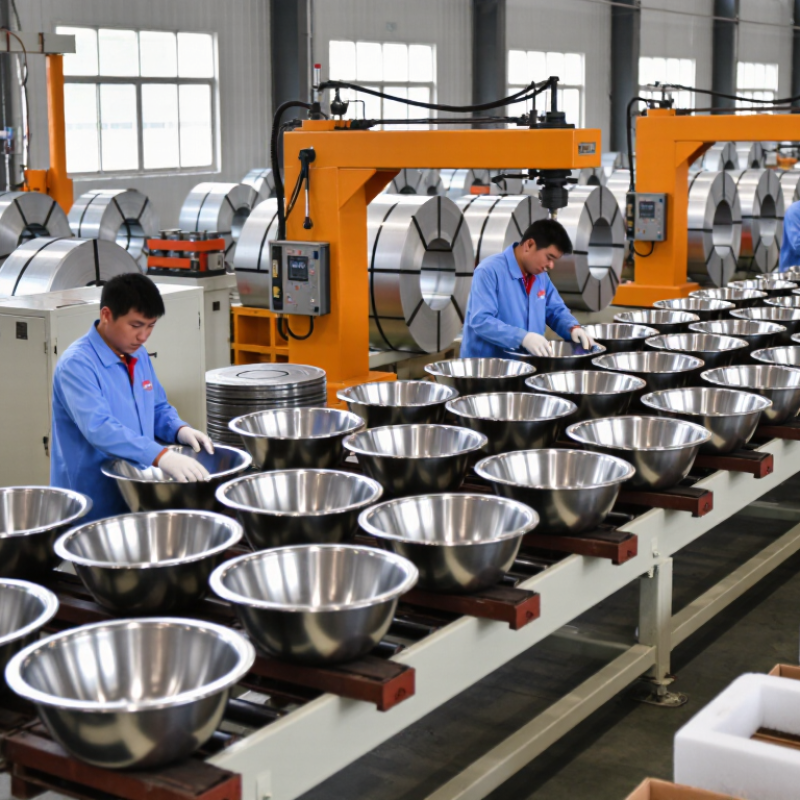
A leading stainless steel basin bowl manufacturer in China is defined by more than production scale. It starts with verified stainless steel grades, accurate thickness, and stable sourcing records. Experienced engineers understand how deep drawing affects corners, wall strength, and surface tension. They should also explain these choices clearly, not hide behind technical language.
Reliable manufacturing appears in small details. The bowl should have even walls, smooth edges, and a drain opening positioned consistently. During production, inspectors can check dimensions with gauges and examine polished surfaces under direct light. Welding, if required, needs clean joints without visible pits or sharp residues. Samples should survive repeated water exposure, cleaning, and handling tests. Not every factory performs these checks consistently.
That weakness deserves attention. A supplier may offer an attractive price but provide incomplete inspection records. Buyers should request material certificates, sample approval, production photographs, and packing specifications. Traceability also matters when a defect appears months later. A capable manufacturer keeps batch information and responds with evidence. Communication is part of quality. Engineers should discuss tooling limits, tolerances, packaging protection, and realistic delivery schedules. Custom work often reveals the truth. Can the factory adjust a bowl design without sacrificing strength or finish? Clear answers, measurable controls, and honest limitations define professional manufacturing more than impressive promises.
A leading stainless steel basin bowl manufacturer should be able to select and process grades according to the required corrosion resistance, formability, and application conditions. This chart compares the typical nominal chromium, nickel, and molybdenum content of commonly used stainless steel grades. Actual composition should be confirmed through mill certificates and applicable standards such as ASTM A240 or EN 10088.
A reliable stainless steel basin bowl starts with its intended use, not its surface finish. Designers measure cabinet depth, drain position, rim width, and user clearance. A bathroom basin needs different proportions from a commercial wash bowl. Small errors can create standing water or difficult installation. Practical testing matters here.
Manufacturers commonly select 304 stainless steel for general indoor use. Grade 316 may suit coastal or chemically demanding environments, although it increases material cost. World Stainless reported 58.4 million tonnes of crude stainless steel production in 2023. This scale supports broad material availability, but it does not guarantee quality. The supplier must verify the mill certificate, thickness, and chemical composition.
Production usually begins with coil slitting and precision blanking. Deep drawing then forms the bowl through controlled pressing stages. Excessive force can thin the corners. Too little force can leave wrinkles. Skilled technicians inspect both problems. Welding may join brackets, drains, or reinforcement parts. The seams are then ground, polished, and cleaned to remove heat discoloration.
A satin finish hides minor handling marks, while a mirror finish demands stricter polishing control. The bowl should also pass leak, dimensional, surface, and drainage tests. ISO 9001-based quality systems can improve traceability, but paperwork alone cannot replace inspection.
One overlooked issue is noise. Thin steel may sound sharp under running water, so some designs add underside insulation. The best manufacturing process balances strength, hygiene, appearance, and installation reality.
Buyers should evaluate the steel grade before comparing price or polish. World Stainless Association data recorded about 58.4 million tonnes of stainless steel production in 2023. That scale does not guarantee suitable basin material. Grade 304 remains a practical choice for kitchens and bathrooms. It contains chromium and nickel, supporting corrosion resistance and a clean finish. Grade 316 adds molybdenum, which better resists salt and chloride exposure. Grade 430 costs less, but it offers weaker corrosion protection in humid or coastal environments.
Ask for a material certificate, heat number, and chemical composition report. ASTM A240/A240M covers stainless steel plate, sheet, and strip requirements. EN 10088-2 defines stainless steel grades and delivery conditions. ISO 9001 certification shows process control, not the actual steel grade. Surface quality also matters. A smooth 2B or polished finish can reduce dirt retention, but appearance alone proves little. A basin may shine beautifully and still have thin walls or poor welds.
Tips: Check thickness with a calibrated gauge. Confirm corner welds, drain openings, and underside reinforcement. Do not trust a magnet test alone; forming can slightly magnetize 304 steel. Request salt-spray or corrosion evidence when the basin will face coastal air. World Stainless guidance supports grade selection by service environment, yet buyers sometimes overlook water quality and cleaning chemicals. That mistake deserves review.
China Best Stainless Steel Basin Bowl Manufacturer?
China remains a major sourcing hub for stainless steel basin bowls. World Stainless reported 58.4 million tonnes of global crude stainless steel production in 2023. That scale creates choices, but not every factory offers equal control.
Compare manufacturers through evidence, not showroom photos. Request mill certificates, grade verification, thickness records, and recent inspection reports. A reliable supplier should explain 304 versus 316 steel clearly. Ask about forming limits, weld treatment, polishing grades, and surface roughness. For food-service applications, request test documentation that matches your destination market.
Customization deserves closer attention. Provide a drawing with bowl depth, rim radius, drain position, tolerance, and finish requirements. Confirm whether tooling belongs to you after payment. Some factories quote a low unit price, then add mold, sampling, packaging, and inspection charges. That comparison is incomplete. Ask for one landed-cost sheet.
Visit the production line when possible. Watch how workers handle deep drawing, edge trimming, and final polishing. Small scratches can appear after packing, not during manufacturing. An independent pre-shipment inspection can check dimensions, quantity, weld quality, and carton protection. ISO 9001 certification helps assess process discipline, but it does not prove every bowl is defect-free. That distinction matters.
Do not rely on one sample alone. Test several pieces from different batches. A supplier may perform well during sampling and weaken control later. This is where my judgment remains cautious: price, capacity, and customization speed often compete with each other. Choose the factory that documents its limits, not the one promising everything.
| Comparison Dimension | Recommended Benchmark | What to Verify with the Manufacturer | Customization Relevance | Reference or Test Method |
|---|---|---|---|---|
| Stainless Steel Grade | AISI 304 / EN 1.4301 for general kitchen and food-contact use; AISI 316 / EN 1.4401 or 1.4404 for higher chloride or chemical exposure. | Material certificate, heat number, chemical composition, and whether the steel is certified for the intended application. | Grade selection affects corrosion resistance, cost, weldability, and suitability for coastal or commercial environments. | EN 10088, ASTM A240, or applicable national material standards. |
| Typical Chemical Composition | 304 commonly contains approximately 18–20% chromium and 8–10.5% nickel. 316 commonly contains approximately 16–18% chromium, 10–14% nickel, and 2–3% molybdenum. | Request a mill test certificate rather than relying only on a product label or supplier declaration. | The selected composition can determine whether a custom bowl is suitable for salt, acidic food, detergents, or wet storage. | Material certificate and laboratory PMI testing when required. |
| Sheet Thickness | Common basin and bowl constructions often use approximately 0.6–1.2 mm stainless steel, depending on diameter, depth, forming method, and load requirement. | Measure finished-wall thickness at multiple points and confirm the permitted tolerance before production. | Thickness influences rigidity, dent resistance, weight, forming difficulty, and shipping cost. | Digital micrometer measurement and approved dimensional inspection plan. |
| Surface Finish | Choose brushed, satin, mirror-polished, or textured finishes according to the design and cleaning requirements. A uniform finish should be free from visible scratches, pits, and discoloration. | Approve a physical sample and define the inspection distance, lighting conditions, grain direction, and acceptable cosmetic defects. | Finish selection affects appearance, fingerprint visibility, cleaning effort, and product positioning. | Visual inspection against an approved golden sample; surface roughness testing when specified. |
| Forming Quality | The bowl should have a consistent wall profile, smooth curves, stable geometry, and no tearing, wrinkling, excessive thinning, or sharp edges. | Review forming samples, tooling capability, dimensional reports, and the supplier’s control of springback and thinning. | Complex depths, tight radii, asymmetric shapes, and integrated features may require additional tooling trials. | Drawing inspection, profile gauge, coordinate measurement, and sample approval. |
| Edge and Rim Safety | Edges should be folded, rolled, or otherwise finished to remove sharp points and cutting hazards. The rim should remain uniform around the complete circumference. | Check edge smoothness manually and confirm the chosen rim construction on the approved drawing. | Rim style affects handling comfort, stacking, appearance, and compatibility with covers or mounting fixtures. | Visual, tactile, dimensional, and functional inspection. |
| Welding and Seam Quality | Welds should be continuous where liquid tightness is required, free from cracks and pinholes, and properly cleaned and passivated when applicable. | Ask for weld samples, leak-test records, weld process details, and evidence of post-weld cleaning. | Custom drain areas, handles, brackets, and multi-part assemblies depend heavily on weld consistency. | Water leak test, dye penetrant testing when specified, and visual weld inspection. |
| Dimensional Accuracy | Critical dimensions should be agreed in a controlled drawing, including outside diameter, inside diameter, depth, rim width, drain opening, and allowable tolerances. | Confirm inspection tools, sampling frequency, first-article approval, and treatment of nonconforming pieces. | Accurate dimensions are essential for cabinet fit, nesting, lids, inserts, and automated filling or washing equipment. | Approved technical drawing, vernier caliper, height gauge, and profile template. |
| Drain and Accessory Compatibility | Drain-hole diameter, overflow position, mounting method, and accessory interface must match the target market and installation system. | Verify compatibility with the specified drain, strainer, waste pipe, plug, rack, or support frame. | Custom openings and accessory interfaces may require dedicated punching, stamping, or forming tools. | Assembly trial with production-intent accessories and functional fit test. |
| Corrosion and Cleaning Performance | The finished surface should resist normal exposure to water and household cleaning agents when the correct steel grade and cleaning instructions are used. | Review passivation or pickling procedures, contamination controls, and any required corrosion-test results. | Surface treatment is especially important for food-service, coastal, medical, and high-humidity applications. | Applicable salt-spray, immersion, or corrosion-resistance test agreed in the specification. |
| Tooling and Prototype Policy | A reliable supplier should explain prototype timing, tool ownership, revision control, maintenance responsibility, and charges before production. | Request a written quotation separating tooling, samples, engineering, and mass-production costs. | Important for non-standard diameters, deep drawing, embossed patterns, logos, and special rims. | Signed drawing, approved prototype, tool register, and change-control procedure. |
| Quality Control and Traceability | Production should be controlled through incoming-material inspection, in-process checks, final inspection, and traceable batch records. | Check inspection plans, calibration records, corrective-action procedures, and batch identification. | Traceability helps manage revisions, repeat orders, complaints, and different material or finish options. | Quality plan, inspection report, certificate of conformity, and retained samples. |
| Packaging and Export Readiness | Packaging should prevent scratches, deformation, moisture damage, and movement during handling and ocean or air transport. | Confirm individual protection, nesting method, carton specifications, palletization, labeling, and export documentation. | Packaging can be customized for retail shelves, e-commerce fulfillment, private labels, or mixed-size shipments. | Packaging drop test or transport simulation when required; packing-list verification. |
Note: The stated material ranges and thickness values are general industry benchmarks. Final requirements should be confirmed through the applicable standard, approved technical drawing, sample inspection, and application-specific testing.
China Best Stainless Steel Basin Bowl Manufacturer?
A basin bowl may serve a commercial kitchen, hotel bathroom, laboratory, hospital, or food-processing line. Each application changes the specification. The World Stainless Association reported 58.4 million tonnes of global stainless steel production in 2023. This scale creates choice, but also inconsistency among suppliers. Buyers should request the steel grade, thickness, dimensional tolerance, and weld inspection records. For damp kitchens, 304 stainless steel is often suitable. Chloride-rich environments may justify 316 stainless steel. A cheap grade can stain around the drain.
Look closely at the working details. A 1.2-millimeter wall usually resists dents better than a thin decorative bowl. Smooth internal corners simplify cleaning. Fully blended welds prevent food residue from collecting. Satin finishes hide scratches, while mirror finishes reveal every handling mark. Ask for material certificates and production samples. A factory audit is useful, although one visit cannot prove every shipment.
The 2024 stainless steel market assessments from Grand View Research identify construction, food processing, and industrial equipment as important demand areas. That supports careful application-based purchasing. Still, market growth does not guarantee quality. Check water-drain speed, overflow design, packaging protection, minimum order quantity, and replacement policy. Request salt-spray or corrosion testing when exposure is severe. I would not select a manufacturer from photographs alone. One overlooked detail, such as a sharp underside edge, can create installation problems.