Inquiry
Form loading...

Top Stainless Steel Wire Rack Types for Global Buyers

Choosing the right Stainless Steel Wire Rack can shape storage efficiency, hygiene, and long-term operating costs. Global buyers often compare mobile racks, wall-mounted units, shelving carts, bakery racks, and heavy-duty industrial designs. Each type serves a different working environment. A busy commercial kitchen may need smooth casters, adjustable shelves, and easy cleaning. A warehouse may prioritize load capacity, shelf spacing, and resistance to moisture or chemicals. Small details matter.

Not every rack performs equally in every market. Stainless steel grades, welding quality, tube thickness, and surface finishing can vary significantly between suppliers. Buyers should request material specifications, load-test information, dimensional drawings, and inspection records before placing an order. Practical experience shows that a polished appearance does not always indicate strong construction. Check the welds closely. Look for stable frames, reinforced corners, secure wheels, and accurate measurements. Certification requirements and packaging standards may also differ by destination, so professional verification remains important. This guide examines leading rack types and explains where each design works best. It also considers cleaning routines, installation needs, customization options, and total ownership costs. Some recommendations may need adjustment after real-world testing. That is worth admitting. A rack selected from a catalogue can behave differently in a humid kitchen, a crowded loading area, or a high-temperature production room. Careful comparison helps buyers choose dependable equipment rather than simply attractive equipment.
Top Stainless Steel Wire Rack Types for Global Buyers

Stainless Steel Wire Rack Basics and Key Design Features

Top Stainless Steel Wire Rack Types for Global Buyers

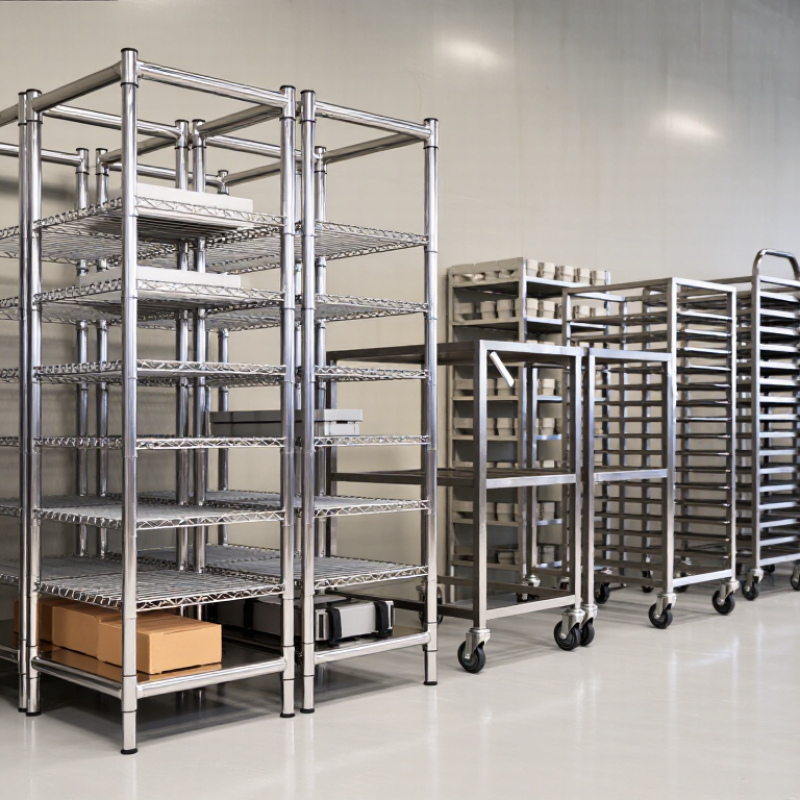
Stainless steel wire racks support storage, drying, transport, and display in demanding workplaces. Common types include stationary racks, mobile racks, wall-mounted units, and adjustable shelving systems. Each type serves a different workflow. A stationary rack suits fixed storage, while a mobile rack helps teams move trays or containers safely.

The basic structure deserves close attention. Stainless steel grades affect corrosion resistance, cleaning routines, and service life. A suitable grade for dry storage may not perform well near saltwater or chemical exposure. Wire diameter influences load capacity, while shelf spacing controls airflow and visibility. Reinforced corners reduce movement under weight. Adjustable feet help level the rack on uneven floors. Casters need reliable brakes, especially on smooth surfaces.

A rack can look strong and still fail under uneven loading. That detail is easy to miss. In practical checks, inspect welds, shelf clips, surface finish, and the connection between posts and feet. Sharp edges can damage gloves or stored materials. Open wire shelves improve ventilation, but small items may need liners or close spacing. Global buyers should also confirm dimensions, packaging strength, assembly instructions, and local load requirements before ordering.

Tips: Match shelf spacing to the smallest stored item. Check the rack under real working weight. Leave clearance for cleaning tools. Avoid placing heavy loads only on the top shelf. Review corrosion conditions honestly; assumptions often cost more later.


Main Types of Stainless Steel Wire Racks by Structure

Top Stainless Steel Wire Rack Types for Global Buyers

Main Types of Stainless Steel Wire Racks by Structure

Stainless steel wire racks should be chosen by structure, not appearance. Open-wire designs improve airflow, visibility, and drainage in food, laboratory, and clean-storage areas. The World Stainless Association recorded about 58.4 million tonnes of global stainless crude steel production in 2023. This indicates strong material availability, but it does not excuse weak rack design.

Welded racks provide rigid frames and quick installation. They suit fixed storage and frequent cleaning. Bolted or clip-in adjustable racks allow shelf heights to change with cartons, trays, or equipment. Stackable units increase vertical capacity without permanent construction. Tiered racks improve picking access, while mobile racks support flexible layouts. Casters can reduce stability on uneven floors. Grand View Research’s 2024 warehouse racking market analysis identifies space optimization as a major demand driver. Structure directly affects that value.

Wire decking supports airflow and sprinkler coverage. Add liners when small parts may fall through the openings. Field inspections often find missing or overly optimistic load labels. That weakness is preventable. Check weld quality, shelf spacing, caster brakes, corrosion resistance, and safe working load. EN 15635 offers useful inspection guidance, alongside applicable local standards. A cheaper adjustable frame may look efficient, but wobble appears during real use. Design for the busiest shift, not the showroom.

Top Stainless Steel Wire Rack Types for Global Buyers - Main Types of Stainless Steel Wire Racks by Structure

Rack Type by Structure Main Structural Features Typical Stainless Steel Grades Assembly Method Mobility Indicative Load per Shelf Typical Applications Key Buying Considerations
Welded Wire Rack Shelves and posts are permanently joined by welded wire intersections and reinforced frames. 304 stainless steel for general indoor use; 316 stainless steel for higher chloride exposure. Factory-welded; usually ready to use with minimal installation. Usually stationary; casters can be added to selected designs. Approximately 100–300 kg, depending on shelf size, wire diameter, and reinforcement. Commercial kitchens, food preparation rooms, laboratories, clean storage, and processing areas. Check weld quality, smooth joints, corner finish, shelf deflection, and cleaning access.
Clip-Together Wire Rack Adjustable shelves connect to vertical posts with split sleeves, clips, or collar-style locking components. Commonly 304 stainless steel; 316 stainless steel is available for aggressive environments. Tool-free or low-tool assembly; shelf height can normally be adjusted in fixed increments. Stationary or mobile when fitted with threaded stem casters. Approximately 90–250 kg, depending on the locking system and shelf dimensions. Retail back rooms, dry storage, kitchens, laboratories, and utility rooms. Verify locking stability, adjustment spacing, caster compatibility, and safe working load.
Boltless Wire Rack Shelves are supported by integrated tabs, keyhole slots, or interlocking beams without conventional bolts. 304 stainless steel is typical; 316 stainless steel may be specified for wet or saline conditions. Push-fit or slot-in assembly; often requires a rubber mallet for final seating. Generally stationary; some models accept casters or leveling feet. Approximately 150–400 kg, subject to frame profile, shelf span, and load distribution. Warehouses, storerooms, workshops, food service areas, and equipment storage. Review joint engagement, frame rigidity, anti-tipping provisions, and maximum bay height.
Folding Wire Rack Hinged side frames or collapsible shelf panels allow the rack to fold into a compact profile. 304 stainless steel is widely used for reusable storage and transport applications. No permanent assembly; unfold and lock the frame or shelves into position. Usually stationary, with some models using wheels or removable casters. Approximately 50–180 kg, depending on the hinge design and locking mechanism. Events, temporary storage, transport staging, hospitality, and space-limited facilities. Inspect hinge durability, locking safety, folded dimensions, and repeated-use performance.
Mobile Wire Rack A wire shelving frame is mounted on four or more swivel casters, often with two locking brakes. 304 stainless steel for most applications; 316 stainless steel for coastal, marine, or high-chloride areas. Clip-together, welded, or boltless frame; casters are installed by threaded stems or mounting plates. High mobility; typically includes two braked casters for positioning and safety. Approximately 75–250 kg per shelf when moved carefully on a level surface. Food service, hospitals, laboratories, cleanrooms, catering, and order-picking areas. Confirm wheel diameter, total load rating, brake performance, floor clearance, and turning radius.
Stacking Wire Rack Individual rack modules have reinforced feet, locating pins, or nesting frames for vertical stacking. 304 stainless steel is common; 316 stainless steel is selected for demanding wet environments. Modules are placed directly on one another or secured with alignment connectors. Stationary; some modular units can be moved individually with lifting equipment. Approximately 100–300 kg per module, subject to stack height and base stability. Crate storage, food processing, warehouse staging, component handling, and cold-room organization. Check stack-lock security, center of gravity, allowable stack height, and floor loading.
Wall-Mounted Wire Rack Wire shelves or baskets are fixed to wall rails, brackets, or vertical support panels rather than floor posts. 304 stainless steel for general use; 316 stainless steel for saltwater or chemical exposure. Mounted with brackets, screws, anchors, or rail systems suitable for the wall substrate. Fixed in place; shelves may be adjustable if mounted on a rail system. Approximately 20–100 kg per shelf, determined mainly by wall construction and anchors. Commercial kitchens, laboratories, wash areas, bathrooms, workshops, and narrow corridors. Evaluate wall strength, anchor type, bracket spacing, installation height, and sanitation clearance.
Over-Shelf Wire Rack A compact upper tier is supported by legs or brackets that sit on an existing counter, table, or workbench. 304 stainless steel is generally suitable for food and laboratory work surfaces. Freestanding, clamp-mounted, or secured with posts and adjustable feet. Stationary; designed for use on a fixed work surface. Approximately 15–80 kg per shelf, depending on span and support spacing. Countertop storage, food preparation, packaging stations, laboratories, and retail displays. Confirm countertop depth, available clearance, foot stability, corrosion resistance, and usable shelf height.

Note: Load figures are indicative ranges for evenly distributed loads under normal indoor conditions. Actual capacity depends on shelf dimensions, wire and post diameter, frame design, span, mounting method, caster selection, floor condition, and the manufacturer’s tested rating.

Choosing Rack Types for Different Storage and Work Environments

Top Stainless Steel Wire Rack Types for Global Buyers

Choosing Rack Types for Different Storage and Work Environments

Choosing the right stainless steel wire rack depends on more than shelf size. Humidity, cleaning routines, load weight, and movement all change the decision.

In a dry storeroom, a fixed four-tier rack offers stable, economical storage. Open wire shelves improve visibility and allow air to circulate around cartons. Keep heavier containers below waist height. That reduces awkward lifting. In busy kitchens, choose adjustable shelves and smooth casters with reliable brakes. Rounded edges matter. They reduce snagging near preparation tables and narrow service paths.

Cold rooms require racks that tolerate condensation and frequent washing. Confirm the steel grade, weld quality, and shelf load rating with supplier documentation. Coastal facilities may need stronger corrosion resistance, but cleaning chemicals still deserve careful review. A rack for medical or laboratory storage should prioritize cleanable surfaces, stable leveling feet, and clear separation between items. Avoid packing shelves tightly; airflow and inspection become difficult.

Workshops often benefit from deeper shelves and reinforced frames for tools or containers. Measure doorways, turning spaces, and floor slopes before ordering. I once focused too much on shelf capacity and overlooked caster clearance. The rack fitted the room, but movement became awkward. That small mistake shows why real workflow testing matters. A sample unit or detailed drawing can reveal problems before full purchasing.

Top Stainless Steel Wire Rack Types for Global Buyers

Typical rated load per shelf by rack type, matched to common storage and work environments. Actual capacity varies by shelf size, caster configuration, and load distribution.

Selection guide: Light-duty racks suit offices and small-parts storage, mobile racks support flexible production areas, heavy-duty racks are designed for warehouses and bulk goods, cleanroom racks provide smooth corrosion-resistant surfaces, and bakery racks are optimized for trays and food-service workflows.

Material Grades, Load Capacity, and Surface Finish Considerations

For global buyers, stainless steel wire racks are not interchangeable. Material grade, load capacity, and surface finish determine service life. Type 304 suits many dry kitchens, laboratories, and storage rooms. It handles routine moisture well. Type 316 is safer near salt spray, chlorides, or frequent washdown. Grade alone is not enough. Weld quality and wire diameter also matter. In field inspections, thin wires often bend before corrosion appears. A rack may look polished, yet perform poorly under uneven loads.

Check rated capacity per shelf, not only total capacity. Ratings should state evenly distributed loads and shelf spacing. A 120-kilogram shelf can fail when one heavy container sits at its center. Use a safety margin, especially on mobile racks. Casters, posts, and locking collars need matching ratings. Measure doorways and lift access before ordering. Small dimensional errors create expensive site adjustments. I have seen racks ordered correctly on paper but unusable beside fixed equipment. That mistake deserves review.

Surface finish affects cleaning, appearance, and contamination control. A smooth electropolished finish reduces crevices around welds. Brushed finishes may hide scratches but can retain residue if rough. Passivation helps restore corrosion resistance after fabrication. Ask for test reports, grade certificates, and cleaning guidance. Verify whether the finish suits chemicals, heat, and humidity. Do not choose mirror shine automatically. It can increase cost without improving performance.

Global Buying Factors for Quality, Compliance, and Delivery

Global buyers usually compare stainless steel wire racks by use, load, and installation space. Shelving racks suit warehouses, while kitchen racks need smooth surfaces and easy cleaning. Mobile racks require stable casters and reliable brakes. Stackable units save space, but they may reduce access during busy operations.

Quality begins with the steel grade, wire diameter, weld consistency, and surface finish. A polished surface should feel even, without sharp edges or dark weld marks. Buyers should request load tests, dimensional drawings, and sample inspections before placing large orders. Details matter. A rack that looks strong may bend under repeated loading. Corrosion resistance also depends on cleaning chemicals, humidity, and temperature, not only the steel label. That point is often underestimated.

Compliance documents should match the actual production model, including material reports, inspection records, and packaging details. Experienced sourcing teams verify measurements against the approved sample. They also check whether certificates come from credible testing channels. Delivery planning needs equal attention. Confirm production capacity, carton protection, pallet size, and port arrangements in writing. A small change in rack height can affect container utilization and shipping cost. Buffer time helps with inspections and customs reviews. However, excessive safety stock ties up cash. The practical answer is not always perfect; it is a documented balance between quality, compliance, and delivery risk.